Am I the only person who’s wondering why the Government has chosen the day when the Leveson Report was published to let Ed Davey launch his energy bill?

Am I the only person who’s wondering why the Government has chosen the day when the Leveson Report was published to let Ed Davey launch his energy bill?
Via James Delingpole

Our beautiful village in one of the prettiest parts of the Northamptonshire countryside is threatened by an industrial wind turbine. We have just 48 hours to stop it. Please can you give 10 minutes of your time to help?
The place: our patch of Northamptonshire – the Staverton Hills – is unspoilt, beautiful and very special. It includes the stone-built villages of Badby and Charwelton, and the glorious Fawsley Estate. At Grad II * listed Fawsley you can wander amid lakes, Capability Brown parkland, medieval ridge-and-furrow pastureland and woods teeming with bats, birds (including all three types of indigenous woodpecker, numerous raptors, waterfowl such as teal and crested grebes), deer, badgers and other wildlife. There’s an Elizabethan haunted house, a 12th century church (where George Washington’s ancestor is buried), a 15th century manor house), the remains of a lost medieval village, Roman roads…. I hope you can all visit one day.
All this is now threatened by a 45 m industrial wind turbine which has been recommended for approval by the district council planning officer. The meeting is on Wednesday 10 October at 6pm. This single turbine is the thin end of the wedge: if permission is granted then the area will be declared an industrial zone and soon many more will spring up like skeletons in Jason & the Argonauts. It will blight the area for years to come, disturbing the peace with its intermittent humming, killing bats and birds, ruining the health of those who live nearby (the closest house is just 600 metres away), ruining the views.
You can help stop this. Just follow the instructions below: (and thanks: I know it’s a hassle but just 10 mins effort on your part could help spare one of Britain’s loveliest spots for more than a generation….)
Please follow these instructions exactly…..
Badby Wind Farm
A wind turbine development is being proposed in rural Northants blighting the rural landscape and sited within 800m of local homes. The initial turbine will be immediately on the right as the A361 climbs from Daventry past Badby.
We desperately need all objectors (from any area in the country) to send a simple email to the council setting out one or more genuine objections. Please email this to at least 10 of your friends to do the same. Numbers count.
For more details on the application go to Planning Application Search and search for DA/2012/0225
To lodge an objection, simply use the template below and insert your objections using your own words.
Every additional email counts – so separate emails from husbands, wives and children all count. Your extra email will make a difference.
Thankyou for helping us prevent another blot on our beautiful countryside.
James Delingpole
=============================================================
**** YOU CAN CUT & PASTE BUT YOU MUST MAKE IT YOUR OWN LETTER BY CHANGING THE WORDS TO SUIT YOUR OWN VIEWS. ****
Mr K Thursfield
Development Control Manager
Daventry District Council
Lodge Road
Daventry
Northants
NN11 4FP
My house
My street
My town
My postcode
6th October 2012
By email: kthursfield@daventrydc.gov.uk
bcc James@jamesdelingpole.com (please note: BCC – BLIND COPY – not CC. so we record submissions properly)
Dear Sir
Planning Application DA/2012/0225
I would like to object to DA/2012/0225 because . . . .
[write your own views in your own words – examples shown below]
1. The site has an adverse impact on the peace and enjoyment of the Special Landscape Area – The Staverton Hills and is in full view of those travelling from Daventry to Banbury.
2. The turbine is less than 1 km of homes and its inappropriate size, and siting adversely affects the quality of life for local residents to an extent that it outweighs any possible benefit or contribution to regional renewable energy targets.
3. Due to its close proximity to local residences there will be noise nuisance, low frequency noise with risk of Arythmia, wind shear and shadow flicker
4. Damage to bats, birds and migration habits.
5. The turbine has an adverse impact on historic and cultural heritage, particularly Badby, Catesby and Grade II listed Fawdsley Estate, the restoration of which is being assisted by Natural England.
6. There is no proper provision within the application for decommissioning.
7. There is no financial assessment of the costs and method of decommissioning, particularly the concrete base.
8. There is no provision in the plan for funding the substantial costs of decommissioning particularly the concrete base.
Yours Faithfully
My Name
===========================================================
Update 20/06/2011
The petition closed on 17th June with a total of 3250 signatories. This may seem fairly modest but by Welsh Assembly Government petition standards it is huge. The previous best was only 1893 signatures.
The effects of this effort are already beginning to feed through into policy with Wales’ first minister Caerwyn Jones announcing that he will be asking the Westminster Government for greater powers to control wind farm and grid developments in Wales. In the meantime, J-Gwen has raised an interesting point in comment #19.
_____________________
I received the following message earlier today. At last there seems to signs of mass resistance to the industrialisation of some of the last remaining truly rural areas of Britain. Tan 8 is a Welsh planning policy document that opens the way to building wind farms even in National Parks and at Sites of Outstanding Natural Beauty. The petition asks the Welsh Assembly Government to reconsider this document in the light of growing public opposition. If you care about such things, do please spare a moment to sign up:
 It’s official, our e-petition is the biggest ever.
Since the National Assembly of Wales e-petition web site was launched, our petition – “Say No to Tan 8 – Windfarms & High Voltage Power Lines Spoiling our Community” has collected the most e-signatures ever, now standing at 2083 (mid afternoon Wednesday 8th June 2011) the previous highest being 1893.
This shows the depth of feeling amongst the people of Wales and beyond to the hideous plans. The closing date is 17th June (mid-day) and anyone who has not signed it is urged to do so, follow the link below or just search for e-petitions on the National Assembly web site.
http://www.assemblywales.org/gethome/e-petitions/epetition-list-of-signatories.htm?pet_id=579
Thank you for all your support
Cartoon courtesy of Josh – more here, or if you really want to let people know how you feel get the the T-shirt
On 22nd October 2010, Business Green had a story headed:
Huhne hints at revival for onshore wind farms
If we like windmills, why not wind turbines, asks Energy and Climate Change Secretary
http://www.businessgreen.com/business-green/news/2272024/huhne-hints-revival-onshore
This included a startling revelation;
“Onshore turbines are something I very much want to look at again and see if we can do more onshore,” he [Chris Huhne] said, adding that recent studies had shown that the cost of onshore wind energy could now compete with conventional energy supplies.
http://www.businessgreen.com/business-green/news/2272024/huhne-hints-revival-onshore
I say startling because I follow what is happening in the wind industry with some interest, and I hadn’t seen any hint of a sudden breakthrough in a technology that may well be the most impractical, uneconomic and environmentally destructive means of generating power for a mass market known to man. So I decided to ask the Department of Energy and Climate Change (DECC) where their secretary of state had got his information form. Continue reading »
Today the US electorate will go to the polls in the mid-term elections. All the signs are that many intend to us this opportunity to wreak vengeance on a fallen idol. Harmless Sky is not concerned with American or any other variety of party politics, but in this case the outcome of the vote may have far reaching consequences for the climate debate. Already there are dark rumours of Republicans planning investigations by Congressional committees into the science that has led to concern about global warming. And Congressional hearings are not the genteel, and perhaps ineffective, talking shops that House of Commons Select Committee hearings seem to have become in recent years.
Roy Spencer has an excellent scene setter on his blog here:
Global Warming Elitism, Tomorrow’s Election, and The Future
The first part of this article also has resonance for a post that I put up a while back about A very convenient network.
H/t to Bishop Hill
_______________
For as long as I can remember, a breakthrough in battery technology that will soon provide a small, cheap and light means of storing large amounts of energy has been just around the corner. Although the demand for better batteries to power laptops has led to some improvement, the state of the technology still falls far short of what the electricity generation industry needs if it is ever going to be possible to iron out the problems created by intermittent supplies from alternatives like wind. Continue reading »
A recent editorial from the Investors Chronicle posed this question about investment in green energy:
Thursday 2 September 2010 – Jonathan Eley, Editor, writes:
What are investors to make of green energy and other sustainable technologies? Instinctively, it should be a “big thing”. Carbon-based fuels are inevitably going to get more expensive, and governments around the world have pledged to spend mind-boggling amounts of money developing green technology and bribing us to adopt it. Yet despite this positive backdrop, picking winners at the company level has been frustratingly tricky – as anyone who’s invested in the sector will know to their cost.
[My emphasis]
It is not surprising that investors should be both puzzled and worried, as a glance at some share performance charts for leading players in the wind power industry shows:
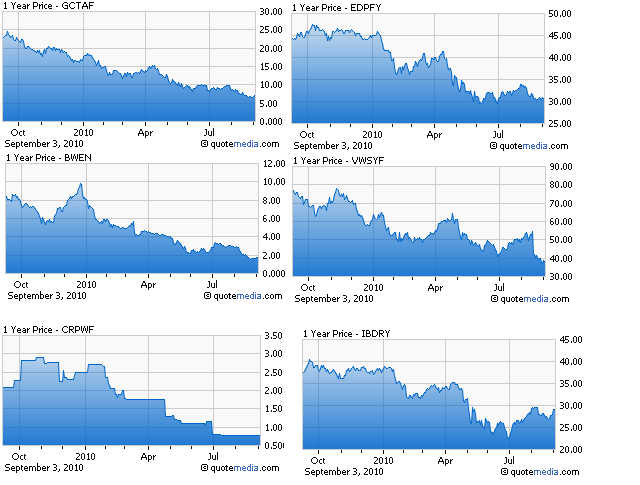
The extent to which public companies involved in what has become known as the green energy revolution can attract the support of investors is, perhaps, one of the more useful indicators of the state of play in the climate debate. However convincingly the IPCC may pontificate about the dangers of global warming and the need to reduce Co2 emissions immediately, and whatever pious aspirations worthy politicians may mouth, this tells us whether rhetoric is translating into action in the real world. Are investors willing to back what they are being told?
A comment elsewhere on this blog drew my attention to an article in the Daily Telegraph by James Delingpole; Wind Farms: the death of Britain. This is truly a cri de coeur in response to the government’s Low Carbon Transition Plan, from someone who obviously still values our countryside. The new white paper on energy sets out plans to build up to 10,000 more wind turbines, 6000 of them onshore, in order to ‘save the environment’, thus setting the scene industrialising most of our countryside and large parts of the coasts.
I just hope that someone is listening to James Delingpole.
On the very day when the Low Carbon Transition Plan was published I had to go to Birmingham, and drove back over Wenlock Edge in late afternoon sushine with the whole of the Shropshire plane and the Welsh Marches laid out in one glorious vista before me. I wondered – and rejoiced – that there could still be so much unblemished rural landscape left in the heart of our small and overpopulated island. It was a sight of stunning beauty and a reminder to anyone who cares to look at it that humans once lived in sympathy with the natural world rather than pretending that the natural world is something that they have control over. And all this within easy reach of a vast urban population living in the West Midlands. Continue reading »
On Wednesday morning, a story headlined Wind ‘can revolutionise UK power’ appeared on the BBC News website. Note the quotation marks; the age old device that hacks love so dearly when they know that what they are about to say may not withstand scrutiny. These are the opening paragraphs:
Wind has the power to revolutionise the UK’s electricity industry, according to a study published on Wednesday.
Research from analysts Poyry says that the UK can massively expand wind power by 2030 without suffering power cuts or a melt-down of the National Grid.
The cost of electricity would then be determined not by consumer demand, but by how hard the wind is blowing.
When it is windy power will be so cheap that other forms of generation will be unable to compete, the report says.
Well that’s good news, or is it? Continue reading »
I’ve been away for about three weeks, and the last few days have been devoted to trying to catch up. Anyone who tries to persuade us that the climate debate is over for all reasonable people should try reading their way back into the subject after even such a short break.At Climate Audit, Steve McIntyre and others are dismembering a new climate reconstruction from Michael Mann of Hockey Stick fame – here. It would seem that, once again, there are many questions to be asked about strange statistical techniques that palaeoclimatologists love, and real statisticians find surprising.
On the three Sundays when I was out of the country, the BBC broadcast a series of programmes on climate change presented by Dr Ian Stewart. I’ve only seen one short clip from this that was posted on YouTube. In this sequence the Hockey Stick is presented as a courageous piece of ground-breaking research that has been successfully defended against unwarranted attacks by ignorant and unscrupulous sceptics. Unfortunately, while Dr Mann is given ample screen time to defend his work, the BBC found it quite unnecessary to allow any sceptic to explain why they have doubts about the Hockey Stick.
Closer to home, there has been the usual backlog of mail to deal with, and this contained at least one interesting item; Continue reading »
From the eastern end of the South Downs it is possible, on a clear day, to look out over one of the most quintessentially English of all landscapes. A vast area of Kent and Sussex countryside lies at your feet, green, undulating, heavily wooded, and tranquil. This is The Weald, known for centuries as the Garden of England. Small villages cluster round ancient churches and farmhouses slumber among well-tended fields, timeless reminders of our rural heritage. Confronted with such beauty it is possible to forget, briefly, that this is also one of the most densely populated parts of the country and one of the most prosperous, and just revel in such a feast for the eyes and balm for the stresses of our modern, industrialised existence
Who could deny that this exquisite prospect is worth protecting? In an age when four fifths of the population live in urban areas, and the government plans to build up to three million more houses, many of them in the countryside, surely there must be some inviolable rules that will ensure that a few vestiges of pristine rural landscape are preserved for the enjoyment of all. Without them we risk losing the ability to see our existence in any context other than that of an industrialised landscape that isolates us from the natural world. Our daily lives will be impoverished by the loss but, even more seriously, we will risk loosing sight of our relationship with the forces of nature, and forget that we are subject to them and not their master.
Well one person who does not see things quite this way is that illustrious television presenter, naturalist, and all round national treasure, Sir David Attenborough. Continue reading »

Recent Comments