As more and more of our precious British landscape is disfigured and by wind farm developments, many of us may wonder how planning authorities can justify some of the decisions that they are taking. On what evidence are they deciding that an important part of our heritage should be sacrificed?The outcomes of planning applications for wind farms largely depend on images that predict what the development would look like. These are produced by photographing the proposed site and then creating a photomontage by superimposing representations of the turbines. There is an old adage that the camera never lies, but this seems not to apply to visual impact assessments. If you want to minimise the visual impact of an elephant in your garden, it is quite easy to do so by photographing it with a wide-angle lens that shows as much background as possible and a very small elephant.

Someone kindly sent me a fascinating document called The Visual Issue that I might not otherwise have seen. It is a detailed, closely reasoned, and very well written critique of the way in which photomontages are used by developers to predict what proposed wind turbine developments might look like. I say ‘might’, because even this scrupulously fair-minded paper cannot disguise the extent to which plausible, but misleading, visual representations are used for this purpose.

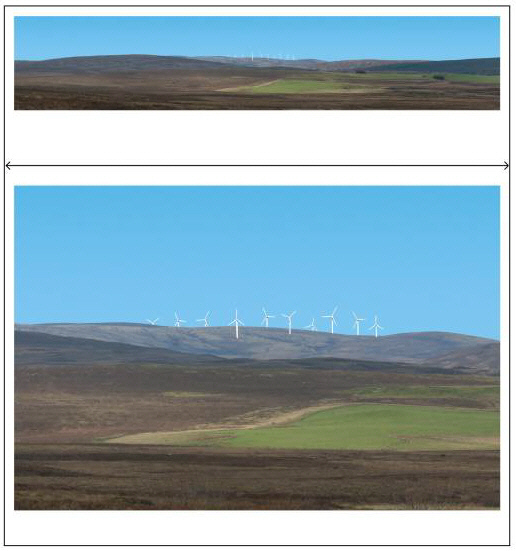
The two images below illustrate this problem dramatically. They were both taken from the same viewpoint, using a standard lens, and demonstrate the shrinking technique employed by developers, although these are simulated images and not pictures of a real wind farm .

Courtesy of Alan Macdonald, http://www.thevisualissue.com/


Clearly the visual impact of the turbines is quite different. In the upper picture they seem quite inconspicuous, small and far away. In the lower one they dominate the landscape and the viewer in a way that is almost threatening. They also seem much nearer although a telephoto lens has not been used.

Alan Macdonald, author of The Visual Issue, is an architect who, for the last 15 years, has specialised in preparing images for clients to use in planning applications, initially in the Far East, but more recently in Scotland. When small rural communities in the Highlands approached him because they were concerned that developers were submitting misleading photomontage for visual impact assessments, he was astonished by what he discovered. Continue reading »

Feb 212008

Below is a comment that Dr Judith Curry posted recently on Steve McIntyre’s Climate Audit blog which gives some insight into the close relationship between science and politics in the minds of many climate researchers.

The author is chair of the school of earth and atmospheric sciences at the Georgia Institute of Technology in the US and a very influential member of the climate science community. She has published research papers that attempt to link an increase in hurricanes to climate change and she serves on various panels related to climate science including the National Academies’ space studies board and the National Oceanic and Atmospheric Administration’s climate-research working group.

Andrew #115, I agree with your statement. While I am not skeptical about increasing CO2 causing warming, there is much to be skeptical about in future projections regarding how much warming. The IPCC makes no pretense of having nailed down “how much warming”, it gives a range of temperature increases even for a specific scenario (Steve, your request for proof of 2.5C sensitivity doesn’t make sense in this context, which is why no one has responded). What do about the warming, given the scientific uncertainties, is a great challenge. However, decision making under uncertainty is something that is routinely faced in all aspects of our life, from government policy to individual decisions. The challenge is to come up with policies and strategies that make sense, even if the warming turns out to be less than expected and will cover us even if the warming is greater than expected. In the U.S. there is a national mandate for energy security, which is almost totally consistent with reducing greenhouse gases. There are numerous health concerns associated with continued pollution of our environment from energy generation. What can we do about it? There is much to be gained from energy efficiency and conservation (for georgia tech’s efforts in this, the largest power user in atlanta, see http://www.stewardship.gatech.edu/2007stewardshipV3.pdf). There are existing alternative energy technologies that are not quite cost competitive with the subsidized fossil fuels we currently use (change the carrots and sticks, and these technologies are cost competitive). There is much promise in a number of new technologies, that need further investment. The other thing we need to do is focus on the socalled adaptation strategies. Whether or not global warming is increasing hurricanes, surely it makes sense to make our coastal cities more resilient to hurricanes. Whether or not global warming is going to increase droughts, surely Georgia needs to figure out how to manage its water resources better and make it more resilient to drought. etc. The bottom line is that such policy decisions don’t hinge on the science of whether the sensitivity is 2 or 3 or 4 degrees.

Dr Curry appears to be saying:

1) We know that there is anthropogenic global warming, but we can’t quantify its extent.

2) We must do something about this even if our understanding of the problem is so limited that we do not even know whether it poses a significant threat.

3) Even if the threat turns out to be illusory, never mind. There will still be benefits from our mistaken and futile attempts at mitigation provided we ignore the economic and social knock-on effects.

This has nothing to do with science, but everything to do with politics, and even in that context it is not a basis for formulating public policy. The desire to address the very real problems associated with pollution and resource management are not reasons for persuading policy makers and the general public that human activity is changing the climate. There seems to be a belief among some climate scientists that AGW alarmism is a legitimate vehicle for drawing attention to these problems and is therefor justified. Again this has no part to play in scientific research, but draws climate science further away from its supposed purpose – to increase our understanding of atmospheric processes – and ever more deeply into the political arena.

If an astronomer who is engaged in research has, let us say, extreme racialist views, then it is unlikely to affect their work. This would not be true of a geneticist, anthropologist or historian. There is an obvious political bias towards environmentalist among climate scientists and it seems unrealistic to expect that this will not compromise their objectivity, however conscious they may be of this danger.

I am not equating racialism with environmentalism, simply using it as an example of a deeply held political belief that is likely to have a profound influence on a person’s world view. I also accept that certain aspects of climate research may lead to the belief that humans are destroying the planet, although this discipline is as likely to attract those who are already sympathetic to this hypothesis. But the risk of unconscious bias is still the same. Only sceptics can provide a counterbalance by questioning the scientific basis for anthropogenic global warming. It is increasingly important that their voices are heard and that their views, if rational, are respected and not dismissed out of hand. This rarely happens at the moment, although Dr Curry’s willingness to engage in discussion on a sceptical blog is a courageous and most welcome development.

News: King of the North Pole

Posted by TonyN on 12/02/2008 at 9:24 am In the News No Responses »
Feb 122008

The problem with retirement is that you still need to have something to do. For many the chance to devote more time to the garden, redecorating the house, compiling a family tree or taking long walks in the countryside may be enough. Others will be content to take each day as it comes, doing a little of this, a little of that, and not being too concerned about doing nothing at all. But what if you have spent your whole life scrabbling your way to the very top of a competitive profession? What will replace the daily adrenalin rush of being in the public eye once you are no longer a main player?

At the end of last year Sir David King stepped down as the Government’s chief scientific adviser after seven years in that post. This is, perhaps, the highest profile job that a scientist can aspire to in this country, and King is not a man to shrink from the attention of the media. Indeed he seems to thrive on any opportunity to keep his name in the headlines. A well calculated sound bite about global warming being a more serious threat than terrorism even landed him in trouble with 10, Downing Street, but he seemed quite unrepentant as he explained on BBC Radio’s Today program recently.

I think there is no other statement that raised the profile at the time of the issue of climate change more. And as a result I’ve actually travelled very widely around the world at the invitation of foreign governments all over the place to talk about climate change and what needs to be done.

BBC Radio4 Toady 20/12/07 8:30am Listen Again

That’s quite a boast, and all that travelling must have been fun too. Continue reading »

Here is an excerpt from a report published in 2006 by the Institute for Public Policy Research, one of the government’s favourite think tanks. It is called Warm Words: How are we telling the climate story and can we tell it better?

Many of the existing approaches to climate change communications clearly seem unproductive. And it is not enough simply to produce yet more messages, based on rational argument and top-down persuasion, aimed at convincing people of the reality of climate change and urging them to act. Instead, we need to work in a more shrewd and contemporary way, using subtle techniques of engagement.

To help address the chaotic nature of the climate change discourse in the UK today, interested agencies now need to treat the argument as having been won, at least for popular communications. This means simply behaving as if climate change exists and is real, and that individual actions are effective. The ‘facts’ need to be treated as being so taken-for-granted that they need not be spoken.

The disparity of scale between the enormity of climate change and small individual actions should be dealt with by actually harnessing this disparity. Myth (which can reconcile seemingly irreconcilable cultural truths) can be used to inject the discourse with the energy it currently lacks.

Opposing the enormous forces of climate change requires an effort that is superhuman or heroic. The cultural norms (what we normally expect to be true) are that heroes – the ones who act, are powerful and carry out great deeds – are extraordinary, while ordinary mortals either do nothing or do bad things. The mythical position – the one that occupies the seemingly impossible space – is that of ‘ordinary hero’. The ‘ordinary heroism’ myth is potentially powerful because it feels rooted in British culture – from the Dunkirk spirit to Live Aid.

(my emphasis)

The first paragraph provides a clear admission that rational arguments have failed to convince the public that anthropogenic global warming is happening. This will surprise few people who have taken an interest in the scientific evidence and the political froth with which it is presented. The IPPR suggest that simulated conviction will be much more effective than being frank with the public; a very ‘shrewd and contemporary way’ of misleading people. All this is chillingly reminiscent of Tony Blair’s claim in parliament that evidence for Iraqi WMD was ‘extensive, detailed and authoritative’, when the Joint Intellect Committee had already warned him that it was ‘sporadic and patchy’. Continue reading »

© 2011 Harmless Sky Suffusion theme by Sayontan Sinha