According to an article at Times Online, the London School of Economics has recieved a £12 million donation to set up a new institute to study the economics of climate change. The philanthropist concerned is Yorkshire born Jeremy Grantham, founder of a  £55 billion investment fund called GMO. He is clearly a very successful investor and has endowed the Grantham Foundation for the Protection of the Environment, from which the funding comes, with £165 million of his own money.

Grantham grew up in Yorkshire and went to university in Sheffield before moving to America in 1968 to take an MBA at Harvard. However, his decision to invest some of his foundation’s money in Britain was not a nostalgic one. It followed the publication of Lord Stern’s report on The Economics of Climate Change and it is now Stern who heads the LSE institute.

Those choices are already paying dividends. The LSE’s research seems likely to play a key role in this December’s UN negotiations in Copenhagen where world leaders will seek agreement on cutting greenhouse gases.

Times Online

Grantham clearly takes ‘the environment’ very seriously. Here is what he told The Times about why he is being so generous:

“Because climate change is turning into the biggest problem humanity has ever faced. I wanted to invest my money in places where it might actually help tackle that problem,”

“We are destroying the planet. We are in the middle of one of the greatest extinctions of species Earth has seen. If it continues unchecked, humanity will soon be running out of food and water.

“What it means is that the environment, especially climate change, is going to be the central issue for all society, including business, politics and the economy. Capitalism and business are going to have to remodel themselves and adapt to a rapidly changing and eventually very different world.”

Times Online

These views extend far beyond the world of mainstream science, all the way to the wilder shores of environmental activism and alarmist propaganda; not at all the kind of speculation that you would expect a respected academic institution like the LSE to be associated with. It would also seem that Grantham has a pretty low opinion of anyone who is not either a scientist or, presumably, a financier like himself:

“Humanity is largely innumerate,” said Grantham. Continue reading »

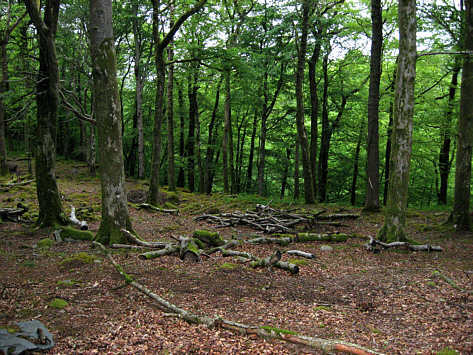
On Friday evening I visited a beautiful beechwood near our house that is famous for its display of bluebells at this time of year, but I didn’t go there to admire wild flowers.

62bluebellwoods2.jpg

At half-past-six on a wet, gloomy and cold evening, about thirty-five local people gathered round a rather nervous looking representative of the Woodland Trust who had arranged the meeting. He was supposed to explain to us why his organisation, which is supposedly dedicated to preserving woodland, had decided to decimate a place that we had all come to love and treasure. For the last eighteen months or so the scream of power saws has polluted the aether as beech trees whose age can be measured in centuries rather than decades were felled.

 felled.jpg

There is something special about a beech wood. The tall, grey, arching trunks, and the canopy that their branches form, are reminiscent of the columns and vaulting of an ancient cathedral. Peace and stillness is to be found in such places, and people tend to speak quietly, in awe of the majesty of their surroundings. Continue reading »

May 122009

Professor Bob Carter will be giving a lecture at 11.00 am on Wednesday 20th May 2009 in the City of London. This is not a public event, but I understand that it may be possible for some members of the public to squeeze in.

If you would like to attend, then please let me know in a comment and I will put you in touch with the organisers.

In April, the BBC told me that my complaint about the out-of-context splicing of phrases from President Obama’s inaugural speech in a Newsnight report by Susan Watts would be considered by the Editorial Complaints Unit. They have now replied at some length: Continue reading »

Al Gore’s film An Inconvenient Truth has recently been shown on two UK public service broadcasting channels. Programme output of this kind is regulated by the Broadcsting Code enforced by Ofcom and I am in the process of submitting a complaint about the way in which what was clearly misleading and politically inspired content was screened without due consideration for the requirements of the code. Here are a couple of relevant clauses, but there are others that also bear on this matter:

2.2 Factual programmes or items or portrayals of factual matters must not materially mislead the audience.

5.12 In dealing with matters of major political and industrial controversy and major matters relating to current public policy an appropriately wide range of significant views must be included and given due weight in each programme or in clearly linked and timely programmes. Views and facts must not be misrepresented.

http://www.ofcom.org.uk/tv/ifi/codes/bcode/

I am in the process of drafting a submission to Ofcom and this is the first part of it: Continue reading »

© 2011 Harmless Sky Suffusion theme by Sayontan Sinha