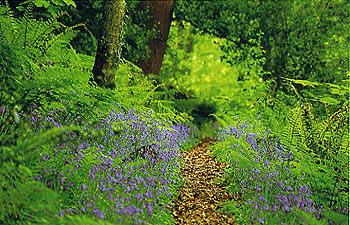
The Woodland Trust (WT) and the Countryside Council for Wales (CCW) have declared that the primary reason for the recent culling of mature beech in Coed Aber Artro was to encourage the regeneration of Atlantic Oak Woodland as part of the Meirionydd Oakwoods Habitat Management Project. The need is arguable; however, with their declarations in mind, it would be useful to note what is actually apparent on the ground within Coed Aber Artro.
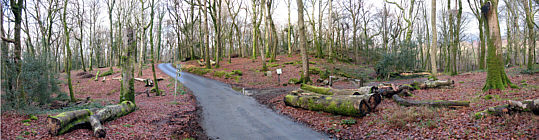
 

pan03ed.jpg

Coed Aber Artro at the time of the felling                                                              Photo: Stephen Coll

If you follow the public footpath east from Llanbedr, on through the WT area and beyond to the Cefn Uchaf campsite, the woodland comprising Coed Aber Artro can be broadly divided into five sectors.
Continue reading »

Jun 192009

On Thursday, the Met Office launched its new report on global warming, UK Climate Projections 2009 otherwise known as UKCP09. This is based on the output of Hadley Centre climate models that predict temperature increases of up to 6°C with wetter winters, dryer summers, more heatwaves, rising sea levels, more floods and all the other catastrophes that one would expect from similar exercises in alarmism.

What makes this report different from any of its predecessors is the resolution of the predictions that the Met Office is making. They are not just presenting a general impression of what might happen globally during this century, or even how climate change could affect the UK as a whole. They are claiming that they can predict what will happen in individual regions of the country. Apparently there is even a page somewhere on their website where you can enter your postcode and find out how your street will be affected by global warming in 2040 or 2080, although I’ve failed to find it.

All this is rather unexpected. In May last year, I posted here and here about a world summit of climate modellers that took place at Reading University. On the agenda was one very important problem for them; even the most powerful super-computers that have been developed so far are not capable of running the kind of high resolution models that they claim would allow them to reduce the degree of uncertainty in their predictions and also make detailed regional predictions that policy makers would like to have so that they can build climate change into infrastructure planning.

Here are a couple of excerpts from the conference website: Continue reading »

Now that the dust is beginning to settle after the elections for the European Parliament, it’s worth asking what part ‘the most serious threat facing us today’ played in the results. Surely climate change must have been in the forefront of most people’s minds as they made their mark on the ballot paper?

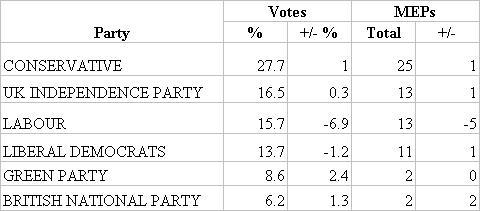
Here are the results for the main contenders:


euro_elections1.JPG


Of the six parties at the top of the list, only one has climate scepticism as a stated policy, and that is UKIP, who came second ahead of the ruling Labour Party for whom the crusade against global warming is a major priority. (For those who are not familiar with UK politics, UKIP’s main policy is withdrawal from the EU.)

The Liberal Democrats, who arguably take an even stronger line on saving the planet, than Labour, lost ground.

The Conservatives, whose pronouncements on climate change attempt to match Labour’s, only increased their share of the vote slightly at a time when they are almost certain to form the next government and were expected to do much better.

So where did all those people who are so concerned about ‘the most serious threat facing us today’ make their mark on the ballot papers? Continue reading »

Jun 062009

Mike Hulme, Professor of Climate Change at the University of East Anglia and founding director to the Tyndall Centre for Climate Change Research, has been in the news again recently. His new book Why we Disagree about Climate Change has led to sceptics – who I suspect have not read it welcoming him to their fold. Even the Daily Mirror, which is not a publication that one might choose to rely on for scientific information, has reviewed the book. So has this eminent scientist who has been at the heart of the climate debate for decades really changed sides?

It is certainly true that he wrote an opinion piece for the BBC News website in 2006 warning his colleagues not to exaggerate their findings in order to attract attention. He even went further and condemned the conference – and associated media campaign – which Tony Blair used as a launch-pad for his newly discovered commitment to the crusade against global warming:

The Exeter conference of February 2005 on “Avoiding Dangerous Climate Change” served the government’s purposes of softening-up the G8 Gleneagles summit through a frenzied week of “climate change is worse than we thought” news reporting and group-think.

By stage-managing the new language of catastrophe, the conference itself became a tipping point in the way that climate change is discussed in public.

http://news.bbc.co.uk/1/hi/sci/tech/6115644.stm

In the same article he said that:

The language of catastrophe is not the language of science. It will not be visible in next year’s global assessment from the world authority of the Intergovernmental Panel on Climate Change (IPCC)

This seems to have been a triumph of hope over experience. No one who has consulted the IPCC’s Fourth Assessment Report could be left in any doubt about the intention of the authors to create alarm, and this was reinforced by the press campaign that accompanied its release. Since then, Hulme has been prepared to criticise the IPCC process too.

Continue reading »


The poet Anne Stevenson has known and loved the Aber Artro woods for many years. She has very kindly permitted me to reproduce a poem from Anne Stevenson: Poem 1955-2005, published by Bloodaxe. Photographer Dave Newbould shares Anne’s concern about what has happened at Aber Artro. Continue reading »

© 2011 Harmless Sky Suffusion theme by Sayontan Sinha