Richard Lindzen (CCNet, 22 July 2009) was too generous by half in his assessment that “although ideally science is independent of moral fashions, in practice there is undoubtedly an influence”.

The history of science is rife with examples of political, social and moral fashions which not simply influence, but pervert the scientific method and corrupt the conduct of scientists. Einstein faced off the political and moral fashions of Nazism and eugenics but plenty of his colleagues happily incorporated those twin systems into their own research. Eugenics also laid the foundations for the moral crusade against alcohol in early 20th Century America which was again a supposedly scientific assessment delivered as a moral panic which must be addressed immediately lest America fall into a deep pit of moral degeneration.

The example of Trofim Lysenko and the political outlawing of Mendelian genetics in Stalinist Russia is a particularly scary example of a political fashion given to be a moral and political imperative by a dangerously unstable man who became President of the Russian Academy of Sciences. The parallels with the modern global warming scare are obvious.

Another example would be neo-Malthusianism as popularised in the 20th Century Continue reading »

Jul 172009

A comment elsewhere on this blog drew my attention to an article in the Daily Telegraph by James Delingpole; Wind Farms: the death of Britain. This is truly a cri de coeur in response to the government’s Low Carbon Transition Plan, from someone who obviously still values our countryside. The new white paper on energy sets out plans to build up to 10,000 more wind turbines, 6000 of them onshore, in order to ‘save the environment’, thus setting the scene industrialising most of our countryside and large parts of the coasts.

I just hope that someone is listening to James Delingpole.

On the very day when the Low Carbon Transition Plan was published I had to go to Birmingham, and drove back over Wenlock Edge in late afternoon sushine with the whole of the Shropshire plane and the Welsh Marches laid out in one glorious vista before me. I wondered and rejoiced that there could still be so much unblemished rural landscape left in the heart of our small and overpopulated island. It was a sight of stunning beauty and a reminder to anyone who cares to look at it that humans once lived in sympathy with the natural world rather than pretending that the natural world is something that they have control over. And all this within easy reach of a vast urban population living in the West Midlands. Continue reading »

Jul 102009

Does anyone remember the unanimous statement on decisive action to combat the global economic crisis that the world leaders handed down from their meeting at L’Aquila this week? You don’t? Well nor do I, actually.

But global warming has its uses if you are a politician stuck for some good headlines, and as second item on the G8’s agenda it seems to have come in handy to save the leader’s blushes.

Apparently the climate is not to be allowed to change by more than 2 °C, and everyone agrees that carbon emissions  should be reduced dramatically by 2050; about the time that most of those gathered at L’Aquila will be learning to play the harp. As to what will be done to achieve this, how it will be done, or when it will be done, they are silent.

But for politicians, with a mighty spin machine to back them up and a poorly informed public as an audience, climate change is so much easier to deal with than economic woes. Here is a selection of first reactions after the meeting that buck the trend:

World leaders, including the developing nations, committed themselves only to “substantially reducing global emissions by 2050”, but failed to agree a specific target. The lack of a substantive agreement, other than the desire to keep global temperatures down, leaves world leaders facing daunting negotiations to reach agreement at the Copenhagen conference in December, which is due to set the entire climate change framework covering the period from 2012 to 2050.

Patrick Wintour and Larry Elliott, The Guardian, 9 July 2009

So all the “Gs” gathered in Italy this week appear to be floundering in their efforts to craft some sort of meaningful deal on climate change. Rich countries agreed to far-off, ambitious targets on emissions reductions, but shuddered at any more immediate commitments. Developing countries basically punted altogether. None of that bodes well at all for the year-end climate confab in Denmark.

Keith Johnson, WSJ Environmental Capital, 9 July 2009

Brazil’s chief climate negotiator criticized the Group of Eight rich nations on Thursday for not taking more forceful steps to curb global warming, saying proposed long-term targets were meaningless.

    Reuters, 9 July 2009

Does the 50% cut by 2050 sound familiar? The same countries agreed at the 2007 G8 summit to “seriously consider” such a target. By 2008, they had moved to “consider and adopt” it. Come 2009, well, we can consider it well and truly adopted.

David Adam, The Guardian, 9 July 2009

So the planet is saved after all. Before you crack open the low-carbonated champagne, consider the weasel wording of the Group of Eight summit communiqué. Are such carefully-hedged words worth the paper they are printed on? What are these politicians committing themselves to do during their own term of office? Most will be dead and buried by 2050.

Paul Taylor, Reuters, 9 July 2009

And of course the BBC, who must have been at a different meeting:

BBC environment analyst Roger Harrabin says the declaration is a significant step, with all big countries – rich and poor – agreeing there is a scientific limit on the amount we can warm the climate.

http://www.harmlesssky.org://news.bbc.co.uk/1/hi/world/europe/8143566.stm

(Hat tip to Benny Peiser of the incomparable CCNet)

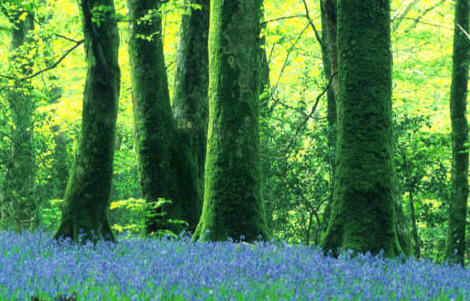
1. In the heyday of the Welsh gentry there was at Aber Artro a dower house of the Corsygedol estate.  From beech planted in its grounds may have come the compact beech wood, beautiful in all seasons and spectacular in bluebell time, celebrated in Anne Stevenson’s poem, “May Bluebells, Coed Aber Artro”, and in Dave Newbould’s photograph –

aberartro-woods2.jpg

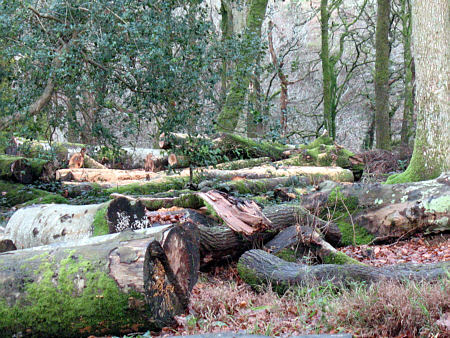
No more.  The brutal culling of the beech (some felled trees are over 3ft in diameter, no recent arrivals) is captured in Stephen Coll’s photographs (“after-comers cannot guess the beauty been”: Gerard Manley Hopkins, Binsey Poplars felled 1879) –

img_1271_ed.jpg

2. To attempt to unravel the mystery of the damage gratuitously inflicted on Coed Aber Artro (“the Coed”) by Woodland Trust (“WT”) and Countryside Council for Wales (“CCW”) – bodies charged with its protection and wholly or partly funded by the taxpayer – is to embark on a strange and surprising journey to Brussels Continue reading »

On this blog, many of us have commented from time to time on the remarkable unanimity of politicians, the media, public institutions and, sadly, scientists about what they see as the clear truths that mankind’s Co2 emissions are the cause of potentially dangerous global warming (now “climate change”) and that painful action is essential to curb such emissions if we, and in particular our grandchildren, are to avoid a dreadful future. As many of us see it, it is extraordinary how these opinions are expressed with such utter certainty in view of the powerful arguments that question that thinking – arguments that rarely get even a hearing in mainstream public discourse. We wonder – how can this have happened?

Well, I have just read an article that may provide the answer. Entitled To become an extremist, hang around with people you agree with, it’s by Cass R Sunstein – who is author of the much admired “Nudge” and an adviser to Obama. It can be found here.

Using the rise of fascism, 1960s student radicalism, the growth of Islamic terrorism, the Rwandan genocide and the 2008 financial crisis as examples, Sunstein argues that there is a general fact of social life that: Continue reading »

Jul 042009


The other evening, Newsnight had a story about the future of space exploration which included an interview with Buzz Aldrin, who was the second man on the moon and by all accounts is a climate change sceptic, although he certainly wasn’t asked about this.

Earlier in the programme, the focused had been on suggestions that instead of leaving everything to NASA, the private sector should play a bigger role. The idea is that technology being developed for space tourism could also be used for other purposes.

There was an interview with a man called Will Whitehorn, President of Virgin Galactic who plan to operate the first scheduled passenger trips into space. They have recently signed a contract with NASA to put a climate research satellite into orbit and are also considering the possibility of feeding back solar power from space and developing server farms in an environment were air conditioning would definitely not be needed. Having established that Virgin intend to diversifying out of passenger transport, which they obviously understand, into the realms of fantasy technology, he then said this:

What people must realise is that space is crucial to the survival of mankind on the planet. Without being in space we wouldn’t even know, to any extent, about the climate change issue.

Mr Whitehorn is clearly not a fool, and he is obviously aware that concern about climate change can open up opportunities for Virgin. What is more puzzling is that he is evidently also aware that the much hyped ‘evidence’ of potentially catastrophic climate change over the last century has actually been so inconspicuous that, if it were not for the space programme, we probably wouldn’t even have noticed.

I’m sure we all wish Virgin Glactica every success, whatever planet they live on.

Jul 022009

On Wednesday morning, a story headlined Wind ‘can revolutionise UK power’ appeared on the BBC News website. Note the quotation marks; the age old device that hacks love so dearly when they know that what they are about to say may not withstand scrutiny.  These are the opening paragraphs:

Wind has the power to revolutionise the UK’s electricity industry, according to a study published on Wednesday.

Research from analysts Poyry says that the UK can massively expand wind power by 2030 without suffering power cuts or a melt-down of the National Grid.

The cost of electricity would then be determined not by consumer demand, but by how hard the wind is blowing.

When it is windy power will be so cheap that other forms of generation will be unable to compete, the report says.

http://news.bbc.co.uk/1/hi/sci/tech/8127177.stm

Well that’s good news, or is it? Continue reading »

© 2011 Harmless Sky Suffusion theme by Sayontan Sinha