
As more and more of our precious British landscape is disfigured and by wind farm developments, many of us may wonder how planning authorities can justify some of the decisions that they are taking. On what evidence are they deciding that an important part of our heritage should be sacrificed?The outcomes of planning applications for wind farms largely depend on images that predict what the development would look like. These are produced by photographing the proposed site and then creating a photomontage by superimposing representations of the turbines. There is an old adage that the camera never lies, but this seems not to apply to visual impact assessments. If you want to minimise the visual impact of an elephant in your garden, it is quite easy to do so by photographing it with a wide-angle lens that shows as much background as possible and a very small elephant.
Someone kindly sent me a fascinating document called The Visual Issue that I might not otherwise have seen. It is a detailed, closely reasoned, and very well written critique of the way in which photomontages are used by developers to predict what proposed wind turbine developments might look like. I say ‘might’, because even this scrupulously fair-minded paper cannot disguise the extent to which plausible, but misleading, visual representations are used for this purpose.
The two images below illustrate this problem dramatically. They were both taken from the same viewpoint, using a standard lens, and demonstrate the shrinking technique employed by developers, although these are simulated images and not pictures of a real wind farm .
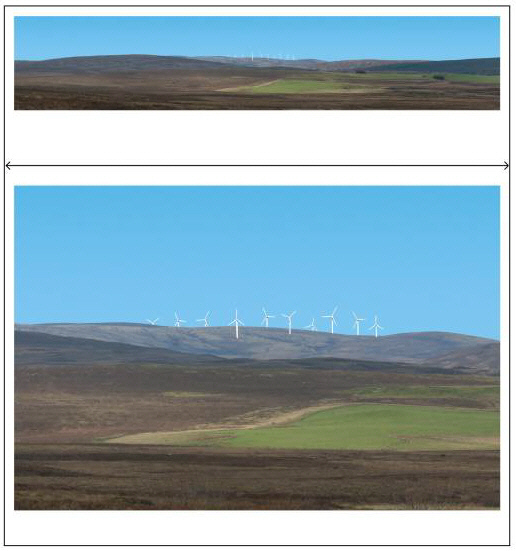
Courtesy of Alan Macdonald, http://www.thevisualissue.com/
Clearly the visual impact of the turbines is quite different. In the upper picture they seem quite inconspicuous, small and far away. In the lower one they dominate the landscape and the viewer in a way that is almost threatening. They also seem much nearer although a telephoto lens has not been used.
Alan Macdonald, author of The Visual Issue, is an architect who, for the last 15 years, has specialised in preparing images for clients to use in planning applications, initially in the Far East, but more recently in Scotland. When small rural communities in the Highlands approached him because they were concerned that developers were submitting misleading photomontage for visual impact assessments, he was astonished by what he discovered. Continue reading »

Recent Comments