
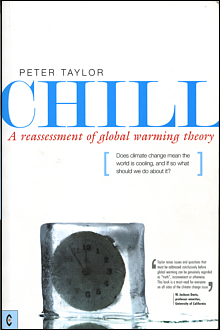
In the first part of his new book, Peter Taylor scrutinises the scientific research that underpins concern about global warming and finds that it is unconvincing. This extract, taken from the second part of the book, looks at the political dynamics that have promoted global warming to the top of the international agenda. As a life-long environmental campaigner Peter is well placed to consider the role that activist organisations have played in this process.
Many thanks to Peter for allowing Harmless Sky to use this material. Click on the image to find out more about Chill.
_____________________________________________________
 In addition to the world of science institutions, governmental influence and media bias, there has also been a growing and powerful environmental lobby pressing for an unequivocal commitment from the scientists. NGOs well appreciated that governments will not move when there is major uncertainty and a lobby has evolved out of a coalition of interests on the part of environmental campaigners and those industries standing to gain from a shift in policy. Naturally, there is also an opposing lobby from oil, gas and coal interests. The nuclear lobby has remained somewhat hidden, but has benefited enormously from the climate issue. Some campaign groups have allied directly to renewable energy interests, especially wind turbine manufacturers and solar collectors, whereas others have remained independent of commercial interests but used the projections of technology and capability to underpin their campaigns.
In addition to these straightforward political alliances, there has been a growing corporatisation of the environmental sector. NGOS have grown from a few small back-street offices into a multi-million dollar international organisation – in the case of Greenpeace, with a fleet of ships, modern office suites, staff and pension funds. Such organisation requires a steady income stream and does not have the option, as for example at the end of a successful ocean pollution campaign to simply pack up and go home. When an organisation’s ethos is essentially combative, it seeks out problems and threats.
Which is fine, as long as there really are serious threats that cannot be dealt with by trusted government. But in my view, as a seasoned campaigner, the game changed significantly after Rio in 1992. The ‘enemy’ metamorphosed from being the dumpers and polluters ably supported by a science- industry alliance (including the modellers), to a more subtle menace. As a result of the shift to the Precautionary Principle, industry and the regulators began to move in another direction – Clean Development Mechanisms were set in motion and large amounts of money shifted toward preventative strategies. This shift required a different type of environmental organisation, and although the campaign groups made significant efforts to provide ‘solutions’, they were still ruled by the old ethos of campaign and combat. Continue reading »

Recent Comments