
News: Sea levels of the future

Posted by TonyN on 31/12/2007 at 2:50 pm The Climate 2 Responses »
Dec 312007

A link on Planet Ark‘s website happened to catch my eye when I was looking for something else on Google recently. This is one of the oldest and most evangelical of the environmentalist websites and it has been very successful in spreading the message of global warming. Sadly Planet Ark seems to be unable to do this without straying into the realms of exaggeration and speculation.

A Featured Link from Planet Ark leads to a page on the University of Arizona website that is rather like Google Earth. There it is possible to see the extent of land areas that would be inundated if sea levels rise as a result of anthropogenic, or any other kind of climate change (here). This would seem to be a perfectly reasonable way of drawing attention to the vulnerability of low lying land, a recurrent theme of advocates of impending global catastrophe. Indeed Planet Ark’s owes its name to fear of rising sea levels; we might all end up in the same boat as Mr Noah. Continue reading »
3 Reading a temperature chart

Posted by TonyN on 24/12/2007 at 10:52 pm The Climate 7 Responses »
Dec 242007


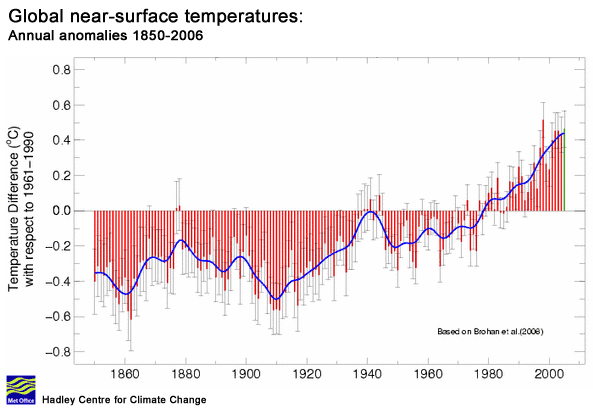
Charts like the one below are becoming more and more common in newspapers and magazines, but not everyone understands what information they actually show. This one is based on research that was used in the recently published report from the Intergovernmental Panel on Climate Change (Brohan, 2006). Temperature is shown in tenths of a degree on the left-hand (Y) axis and time on the bottom (X) axis.

There are no prizes for guessing that the wavy blue line relates to the global temperature since 1850, or that it shows an overall rise in temperatures. We can also see that there was a certain amount of variation in temperatures during the 19th C, but without any particular trend either up or down. From about 1910 onwards, temperatures rose until the 1940s, when the trend reversed sharply and it got cooler. From about 1975 until the end of the century there was another upward surge comparable to the one at the beginning of the century, then the line begins to level off at the present time. It all looks pretty dramatic and, some might say, scary. Continue reading »

Dec 172007

Most of us rely on the media to form our opinions on current affairs, but few of us would claim that newspapers, television and the radio are entirely impartial and reliable in their news coverage. This can be particularly true when the stories that they are reporting are likely to catch the public’s imagination and add a little drama to their lives.

Three years ago I started to research a book about the British landscape, and particularly the countryside. Wind farms were beginning to appear in remote and beautiful rural areas, introducing conspicuous industrial development to places that had formerly been rigorously protected — with the general support of the public, politicians and planners — from such intrusion. Although small groups of protesters were vigorously objecting to planning applications at a local level, there was no public outcry or general support for their cause. This seemed strange, because I had always thought that the unique beauty of the British countryside was a vital part of our heritage, to be enjoyed, and jealously guarded, by all.

It seemed to me that our attitude to the countryside was changing, and I wanted to understand why this was happening. Monitoring media coverage of wind energy was an obvious first step. It appeared that the merit of wind farms was being heavily promoted by government, environmental pressure groups and the British Wind Energy Association, and that many of the claims that were being made for this new panacea for pollution were, at the very least, exaggerated. Continue reading »

Dec 162007

Earlier this year, the Royal Commission on Environmental Pollution published a report entitled The Urban Environment. The official summary of this vast document begins with the following startling assertion;

For the first time in human history, more than half the world’s population lives in urban areas. Around the world, mega and super cities with tens of millions of inhabitants are rapidly expanding. In the UK, over 80% of the population already lives in urban areas, and the country is going through a new phase of urban expansion and regeneration that will affect the way we live for decades to come.

I say ‘startling’ because I doubt whether many people in the UK think of their homeland as being predominantly urban. Continue reading »

© 2011 Harmless Sky Suffusion theme by Sayontan Sinha