
A very experienced hydrologist using the internet handle Potentilla has been commenting at Harmless Sky recently. This post is based on what he has said with some general context and observations added by me.

Regarding a recent article in the Guardian, Potentilla commented:

Here is a good example of how Guardian journalists allow themselves to be lead by the nose by scientists eager to make their research relevant.

World’s glaciers melting at accelerated pace, leading scientists say

This article is by the paper’s US environment correspondent, Suzanne Goldberg, dateline 20th January 2010. It’s based on what Lonnie Thompson had to say in ‘a conference call with reporters’, and there is additional input from the Union of Concerned Scientists. Evidently this was quite a media event with a cast list that might cause any AGW sceptic to prick up his or her ears.

Given that the story relies on published scientific research, Guardian readers are likely to just accept it as holy writ.

The purpose of the article is clearly damage limitation in the wake of the scandal involving the IPCC’s unjustifiable prediction that the Himalayan glaciers may disappear by 2035.

Lonnie Thompson is best known — to the general public — for the claims made about his research by Al Gore in his film An Inconvenient Truth. These centred on research that seemed to indicate that the ice on the summit of Mount Kilimanjaro would soon disappear because of climate change, and also what Gore described as “Dr Thompson’s Thermometer”, but was in fact the infamous Mann Hockey Stick graph.

Since those heady days when it seemed that most people, and all politicians, would believe anything they were told about global warming, things have changed a bit.

The suggestion that global warming was destroying ice cover on Kilimanjaro has been shown to be unfounded and Lonnie Thompson’s steadfast refusal to archive ice-core data on which much of his other research is based so that other scientists can reproduce his findings has been the subject of much controversy.  Shades of Climategate.

The Union of Concerned Scientists, a highly politicised US environmental lobby group, were responsible for the myth that 98% of scientists believe that AGW is real. This finding dominated discussion of climate science for years and did much to foster the belief that ‘the science is settled’. Apparently the only basis for their claim was a rather sparse response to a poll of their own, no doubt environmentally committed, members. A list of other contentious utterances from this organisation would be far too long to include here.

Potentilla continues:

There is an alarming paragraph in the Guardian article referring to a paper, of which Thompson was a co-author:

Glacier melt is also threatening water supplies, the UCS said, pointing to a 2008 study in the Himalayas which showed less water flowing from the glaciers to the great rivers such as the Indus, Ganges and Brahmaputra that sustain the Indian subcontinent.

Interesting I thought, an actual study on the effect of climate change on the hydrology of the south Asian rivers.

The title of Thompson’s paper is ‘Mass loss on Himalayan glacier endangers water resources‘, and was published in Geophysical Research Letters (GRL), the American Geophysical Union’s very prestigious journal.

The abstract of the article ends with this sentence (emphasis added):

If climatic conditions dominating the mass balance of Naimona’nyi extend to other glaciers in the region, the implications for water resources could be serious as these glaciers feed the headwaters of the Indus, Ganges, and Brahmaputra Rivers that sustain one of the world’s most populous regions.

Closer examination shows that the study only addresses mass loss from a single glacier in the Himalayas. It does not address the hydrology of the rivers at all. I don’t think there is even a single hydrologist on the crowded study team.

The scientists may think they have covered themselves with their speculation about the potential impact on water supplies by inserting the “if” and “could be”. But this is disingenuous. They have not even addressed the hydrology in a serious way. The last sentence in the abstract appears to have been inserted to make the research more relevant, a tactic that is quite common. I have served on funding committees for research organisations and the potential impact i.e. importance, of research is a component that is given high marks in funding decisions.

The symbiotic relationship between scientists, trying to advance their career interests and journalists, who do not investigate what they are writing about, seems to be a common phenomenon.

What is actually quite ironic is that during periods when glaciers are losing mass balance as a result of melting, low flows in downstream rivers actually increase. Note the Guardian’s statement, [evidently based on what the Union of Concerned Scientists has told their ace environment correspondent]  that:

“…a 2008 study in the Himalayas which showed less water flowing from the glaciers”

[which, of course is Lonnie Thompson’s ground breaking paper on the Himalayan glaciers]

If the glaciers are currently losing mass balance due to melting, this statement is incorrect.

And bear in mind that this article in the Guardian is an obvious attempt to re-establish confidence in IPCC warnings after the recent ‘all gone by 2035′ debacle that the Himalayan glaciers are retreating and the consequences will be catastrophic.

I think this example is a good illustration of how we have got into this mess. There is a huge gap between the earnest and serious efforts of many climate scientists, glaciologists etc and the implied certainty of climate catastrophe that you read in the mainstream media (MSM). The link across the gap is very weak but most scientists seem to “go along” with it, or keep quiet because inflating the importance of research is in their interests. The MSM and politicians promote it because presumably catastrophe sells.

It is a misconception that loss of the Himalayan glaciers would affect hundreds of millions of people. Glaciers have a limited effect on the hydrology of large river basins such as the Ganges primarily because the glaciated area is only 1.6% of the whole river basin area. Communities a short distance downstream from a glacier benefit from increased low flows in the summer months. This is offset by the water generally being laden with sediment. For people living a great distance downstream, the loss of the glaciated area would not be noticeable though it would be picked up by accurate flow monitoring stations.

Dry season flows in the lower part of large river basins are sustained primarily by groundwater discharge not glacier melt. If we take the results from the global climate models at face value they actually predict an increase in precipitation in the Himalayas. So overall the IPCC should have concluded that there would be more water available in rivers with sources in the Himalayas.

Despite the  title of Thompson’s  paper, ‘Mass loss on Himalayan glacier endangers water resources,’ it does not address in any meaningful way the endangerment of water resources. The type of research that would be necessary to support the statements in the paper would involve developing a hydrological model of the whole Ganges River Basin, calibrating it to recorded flows and water usage and then simulating river flows without the glaciers.  This is relatively straightforward in concept but nothing like this was attempted in the GRL paper.   The paper is only about mass loss from a single glacier. The title appears to have been chosen by the authors to inflate the importance of the paper and does not reflect the content accurately. Although this is a GRL paper and peer-reviewed, clearly no attempt was made by the reviewers to correct the impression given by the title.

Maybe we should not be too hard on the Guardian journalist as the title and conclusion of the paper misrepresents the actual research conducted. It is discouraging that “peer-reviewed” papers can be used by others to promote the notion of climate catastrophe when the scientific research does not support, or even address, the speculative conclusion.

It would seem that most of the blame here lies with the scientific community though it is a shame that the MSM seem to have abdicated their traditional role of investigative journalism.

Anyone reading the Guardian article who is not very familiar with this area of research and bear in mind that this is a newspaper that is much read by policy makers and journalists would quite reasonably assume that it carried the authority of published scientific research. And they would be right.

The IPCC’s oft repeated claims that all the findings in its reports have been peer reviewed is a  cornerstone of the climate change debate.

During the last week or so we have discovered that that is not true. But what are we to think when the Guardian, in conjunction with the Union of Concerned Scientists and a very well known climate scientist, tell us that although there may have been a problem with the IPCC’s estimate of when the Himalayan glaciers might cease to exist, there is no need to worry about the integrity of their other predictions. The rest of the science is robust, they say, and this was just an isolated incident.

The mantra that is used again and again to bolster many of the more alarming claims that are being made by climate scientists is ‘this is peer reviewed science’. There can be little doubt that the paper referred to above was peer reviewed, and it certainly appeared in one of the most respected scientific journals. Yet there still seems to be room for considerable doubt about what it says because it’s primary conclusion is speculative and not supported by the narrow scope of the scientific research reported in the paper.

Potentilla concludes:

A recent presentation at an AGU meeting in December dismisses the concern over the impact of Himalayan glacier loss on water supply with a conclusion similar to Potentilla.

As we have calculated, melting glaciers (specifically, negative mass balance components of the melt) contribute an estimated 1.2% (perhaps factor of 2 uncertain) of total runoff of three of the most important drainages, the Indus, Ganges, and Brahmaputra combined. The seasonal flow regulation influences and the negative mass balance is more important in local drainages close to the glacier sources, where glaciers can dominate the hydrology in arid regions, but on the scale of the subcontinent, glaciers are secondary players in looming hydrologic problems, which stem more from population growth and inefficiency of water resource distribution and application.

Glaciology research in the Himalayas is undoubtedly of value and is relevant for understanding climate variability.  Understanding of glacier hydrology is also important for hydrological studies of the Himalayan rivers as one component of a broader investigation.

However in the Thompson paper, an assumption was made about the impact of the glacier research findings on the hydrology of major rivers in southeast Asia. It is the assumption that has been used to promote the research with the media, not the actual research findings of the study.

In the aftermath of Climategate, with accusations of partiality and subterfuge being exercised in the peer review process, and growing suspicion about researchers who refuse to archive their data so that it can be checked by those outside the charmed circle of climate scientists, there is still much more to be concerned about.
PACHAURI'S DEATH WARRANT

Posted by TonyN on 30/01/2010 at 7:14 pm The Climate 11 Responses »
Jan 302010


A report in The Times accuses the chairman of the IPCC of knowing before the Copenhagen conference that the claim in AR4 that the Himalayan glaciers could disappear by 2035 was wrong:

Rajendra Pachauri was told that the Intergovernmental Panel on Climate Change assessment that the glaciers would disappear by 2035 was wrong, but he waited two months to correct it. He failed to act despite learning that the claim had been refuted by several leading glaciologists.

The IPCC’s report underpinned the proposals at Copenhagen for drastic cuts in global emissions.
Full story here

Just in case there should be any doubt about this, The Times reveals that:

… a prominent science journalist said that he had asked Dr Pachauri about the 2035 error last November. Pallava Bagla, who writes for Science journal, said he had asked Dr Pachauri about the error. He said that Dr Pachauri had replied: “I don’t have anything to add on glaciers.”

and: Continue reading »

BBC Election Guidelines

Posted by TonyN on 29/01/2010 at 10:18 pm Politics, The Climate 10 Responses »
Jan 292010

The BBC is conducting a consultation on their guidelines for covering the general election.  There is a web page that tells you all about it here:

https://consultations.external.bbc.co.uk/departments/bbc/consultation-on-the-bbc-election-guidelines/consultation/consult_view

This provides the opportunity to complete an on-line questionaire or to make a written submission to the BBC Trust

It seems very likely that climate change will  play a relatively small part in the general election campaign when it starts. This is partly because all the main parties are singing from the same hymn book on this subject, but also because there are very real pitfalls for them all if the electorate make the connection between action to reduce Co2 emissions and increased fuel costs, travel costs, and taxation. So it is possible that the electorate will not have an opportunity to assess the various parties’ policies on these matters.

Opinion polls constantly show that when people are asked about global warming they are, at best, lukewarm in their concerns, ranking it way down the list of policy priorities. On the other hand, if they are asked about their willingness to dig into their pockets to fund mitigation policies, the response tends to be far more definite and extremely negative. The prospect of a greater burden on commercial and household budgets is not welcomed at all.

All the main political parties are committed to environmental policies that will cost a very great deal of money, but none of the main parities are likely to include that fact in their per-election boasts. So those who are worried about the financial consequences of such measures will get little opportunity to find out precisely what each of them is likely to do if it gets into government. And bear in mind that there may be a hung parliament, so for once it really does matter what the Liberals think.

Surely it is very important that commonly held views which are not represented by the political parties are heard during the election campaign. An election is, or at least should be, about the preferences of the electorate when they choose who is to represent them in Parliament. Reporting and commentary during the campaign should not be restricted to the agendas that politicians set.

The BBC guidelines are intended to ensure that there is no bias for or against any political party, but it is their broader duty to make sure that the whole spectrum of opinions held by the electorate is represented in broadcast output. What the politicians are not prepared to put in their manifesto’s, speak about at the hustings or advertise in their publicity campaigns  is as important to the electorate as the promises that are being dangled before them in an overt attempt to secure votes. True impartiality on the part of our national broadcaster can only be achieved if they cover these aspect of the election too. Their responsibility is to the general public, who are the electorate, and not to the politicians.

If you feel like helping the BBC with their consultation, then no doubt they will be very grateful, but don’t delay. There is a closing date of 2nd February 2010. Here’s the link again:

https://consultations.external.bbc.co.uk/departments/bbc/consultation-on-the-bbc-election-guidelines/consultation/consult_view

Jan 272010

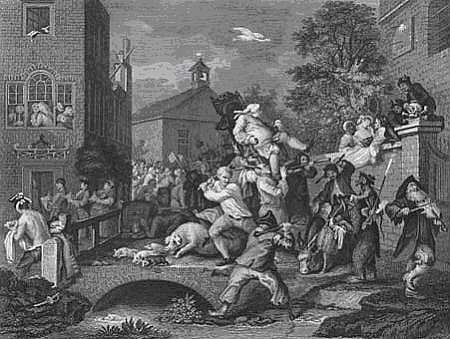
hogarthelection2.jpg

William Hogarth  Election Celebration

This post is in response to a number of comments made by regular contributors to Harmless Sky on the Tory Environmentalism – is everybody listening? thread. Here, Here, Here, Here.

Geoff Chambers says, ‘There’s a fascinating debate to be had on the effect of the current global warming catastrophe on British politics and media coverage …’ And of course he’s right.

We’re approaching the first general election that is likely to bring about a change of government in over a decade, and the previously remorseless march of AGW alarmism is beginning to falter, so how could it be otherwise? It would be difficult to get a cigarette  paper between the three main party’s policies on this subject, but opinion polls constantly show that the politician’s apparent certainty is not shared by the electorate. Something has to give.

Geoff then goes on to consider the role of politics on this blog, assuming that this area of discussion is entirely off limits. That is not the case.

What the blog rules actually say is:

Politics:
It certainly isn’t possible to discuss climate, the countryside and landscapes without straying into this minefield, although I wish that this was not so. Please try to be reasonably moderate in your utterances and avoid party politics altogether. There are plenty of other blogs that deal with such matters.

This is an un-moderated blog, but when I do occasionally step in editorially, it is almost always because discussion of a political aspect of climate change has drifted on to other unrelated political issues, got heated, and ended up a long way from the subject matter that Harmless Sky is intended to cover.

I have particularly requested that contributors should avoid party politics as there are few people who can conduct a party-political debate objectively, and a rough-house that creates much heat and very little light usually ensues. This kind of thing may be fun for those directly involved, but it tends to be tedious if you have to read it, and I do have to read it.

For at least the next six months (assuming that the election takes place in May) I’m prepared, in fact eager, to see comments drawing attention to any differences that may emerge in the various parties’ policies relating to climate change, or any other environmental issues for that matter. However that does not mean that discussion of the Labour Party’s latest green initiative will be allowed to become a knock-down-drag-out fight over the relative economic competence of the main parties, or whether the prime minister is attempting to subvert democracy. And I am all too familiar with the trick of rounding off a five paragraph rant about foreign policy with a spurious reference to alternative energy. Such efforts are likely to be snipped in toto.

You have been warned.

That said, I would not be surprised if the coming election campaign provides the opportunity for the blogosphere to really come of age. Time strapped journalists rely more and more heavily on recycling press releases without proper investigation, or consideration of the motives of those who provide them. This is leaving huge gaps in the spectrum of news and opinion that the MSM covers, and the range of opinions that it considers. There is so much that concerns people that rarely, if ever, receives any attention. Sometimes I think that large parts of the press are now like disk jockey’s who have become used to just reaching out to a carousel for the next disc , but never wonder when the contents of the carousel was last updated. We seem to hear the same old tunes over and over again.

As a result, there is an emerging trend towards the new web-based media influencing the  news agenda. Just ask yourself whether Climategate could have happened without the blogosphere? Or whether the utter futility of the Copenhagen summit would have become apparent so quickly without there being an alternative to the deceptively up-beat spin flooding from governments and organisations that had most to lose as a result of its failure.

Geoff also says:

I’ve often felt the rough and tumble of blog discussions reproduces the long-lost art of political all-in wrestling, of the kind you see in Hogarth’s illustrations of 18th century election campaigns. The point wouldn’t be to score party political points, but to get some heat into the discussion …..

This conjures up an intriguing image, but I doubt whether he really thinks that political persuasion with the aid of a cudgel would reinvigorate political life. On the other hand, it does seem likely that this election will be very different from those since 1997, and there may be copious amounts of metaphorical Hogarthian blood on the carpet before the campaign is over.

There seem to have been two distinct types of election in recent history. Firstly, there are those where the electorate hardly seem to be interested in the outcome because they expect the status quo to be maintained regardless of who wins. Such elections are characterised by unremarkable political leaders and a desire to see no more than a minor touch on the helm of the ship of state.  Then there are elections that take place when the whole nation is galvanised by the possibility of a major change in the fundamental priorities that determine public policy. The elections of 1948, 1963, 1987, and 1997 are examples. It seems possible that, in due course, 2010 will join their ranks, but in this case there may be one very important difference: important issues that concern the public may not being addressed at all. Blogs can help to prevent this happening.

In another post, I mentioned an article by Matthew d’Ancona that castigated the political classes, and all parties, for arrogantly failing to engage with the public and acknowledge their views because they are inconvenient. The examples he chose were the MP’s expenses scandal and global warming. The days when  MP’s could afford to ignore what is discussed on blogs is over,  and the large proportion of new members that will be elected this year are far more likely to be aware of this than those who they will be replacing.

Just a year or two ago, bloggers endlessly discussed what was in the MSM, but had little impact on the news agenda. There was little or no sign that mainstream journalists and editors were interested in what bloggers said or did. As each month goes by the influence of the blogosphere is increasing because more and more of the public are seeking news and opinion on the internet rather than on paper, television or the radio. The MSM now have to compete for the audience not just among themselves, but with a whole new world of output.

In a blog post on the BBC website, Andrew Neil as experienced a journalist as you can expect to find has drawn attention to this point. His extremely hard hitting round-up of all the tribulations that have beset the once cosy and complacent world of mainstream climate science since the release of the CRU emails includes this obsevation:

The bloggers, too easily dismissed in the past, have set the pace with some real scoops — and some of the mainstream media is now rushing to catch up.

The Dam is Cracking

Wise editors understand what their readers want, either instinctively or by spending money on market research. Looking at where the heavy blog traffic is to be found can be much cheaper than commissioning opinion polls and focus groups.  In the case of climate change, the mere number of web sites that deal with this subject from a sceptical point of view, and the traffic they get, must tell them something. They will also be aware that when they publish articles about global warming on their own websites, a large proportion of the comments they receive are sceptical.

Opinion polls show that the UK public rank concern about global warming very low in their list of priorities, but when it comes to policies that will lead to higher fuel bills, increased taxation, despoliation of the countryside, restrictions on travel and massive payments to the developing nations that is a very different matter. The public are very interested in these issues.

It is unlikely, if Matthew d’Ancona is right and politicians are so immersed in their own bubble that they have become divorced from the electorate, that climate change will play any greater role in the UK general election campaign than it has in recent by-elections, council elections and European elections unless somethng happens to dispel their complacency. If there is an outcry in the MSM against expensive proposals that will supposedly avert climate change, that would be something the main political parties would be unable to ignore.

Geoff is probably right, a rumbustious and widely populist outcry on the net could have an effect, not directly, but as a result of the message that it would send to the MSM, and if they fall into line then there is no way that politicians will be able to duck these inconvenient issues.

If Geoff’s dream of a truly Hogarthian election campaign comes true, I would not want to be part of it, but relying on the same period in history, there is a very obvious parallel that can be drawn between the 18th century pamphleteers and bloggers. In both cases radical voices became audible because concerned individuals were able to mobilise cheap means of mass communications to spread their views. And there is another similarity. Their pamphleteers ideas only spread because their publications were passed hand-to-hand, in much the same way that information on the net goes viral and spreads by links from site to site.

Although the notion of a rumbustious, rough and tumble 18th century style election campaign might have its charms, it would be unwise to take this analogy too far. Radical politics in the 18th century culminated in the French Revolution.

Now, where’s that guillotine?

I received a message from David Holland this evening with this astonishing news:

The alleged conspiracy of scientists at the Climatic Research Unit to thwart Freedom of Information inquiries has prompted the UK Information Commissioner’s Office to seek a change in the law so that it could seek prosecutions against researchers who commit similar offences.

The Office of the Information Commissioner has issued the following statement:

Graham Smith, Deputy Commissioner, said:

“Norfolk Police are investigating how private emails have become public.
The Information Commissioner’s Office is assisting the police investigation with advice on data protection and freedom of information.

The emails which are now public reveal that Mr Holland’s requests under the Freedom of Information Act were not dealt with as they should have been under the legislation. Section 77 of the Freedom of Information Act makes it an offence for public authorities to act so as to prevent intentionally the disclosure of requested information. Mr Holland’s FOI requests were submitted in 2007/8, but it has only recently come to light that they were not dealt with in accordance with the Act.

The legislation requires action within six months of the offence taking place, so by the time the action taken came to light the opportunity to consider a prosecution was long gone. The ICO is gathering evidence from this and other time-barred cases to support the case for a change in the law. It is important to note that the ICO enforces the law as it stands – we do not make it.

It is for government and Parliament to consider whether this aspect of the legislation should be strengthened to deter this type of activity in future.  We will be advising the University about the importance of effective records management and their legal obligations in respect of future requests for information. We will also be studying the investigation reports (by Lord Russell and Norfolk Police), and we will then consider what regulatory action, if any, should then be taken under the Data Protection Act.”

As I understand this statement, the only obstacle to prosecution is the very strange time limit in the legislation. The Information Commissioner seems to be satisfied that there were grounds for prosecution.

I can think of nothing more to say about this at the moment except that I hope questions will be asked about why  such an obvious loophole in this legislation, which came into force a decade ago, has not been stopped up.

The House of Commons Science and Technology Committee are to investigate Climategate with terms of reference that should send a chill down a few spines at UEA:

THE DISCLOSURE OF CLIMATE DATA FROM THE CLIMATIC RESEARCH UNIT AT THE UNIVERSITY OF EAST ANGLIA

The Science and Technology Committee today announces an inquiry into the unauthorised publication of data, emails and documents relating to the work of the Climatic Research Unit (CRU) at the University of East Anglia (UEA). The Committee has agreed to examine and invite written submissions on three questions:

– What are the implications of the disclosures for the integrity of scientific research?

– Are the terms of reference and scope of the Independent Review announced on 3 December 2009 by UEA adequate (see below)?

– How independent are the other two international data sets?

The Committee intends to hold an oral evidence session in March 2010.

Background

On 1 December 2009 Phil Willis, Chairman of the Science and Technology Committee, wrote to Professor Edward Acton, Vice-Chancellor of UEA following the considerable press coverage of the data, emails and documents relating to the work of the Climatic Research Unit (CRU). The coverage alleged that data may have been manipulated or deleted in order to produce evidence on global warming. On 3 December the UEA announced an Independent Review into the allegations to be headed by Sir Muir Russell.

The Independent Review will:

1. Examine the hacked e-mail exchanges, other relevant e-mail exchanges and any other information held at CRU to determine whether there is any evidence of the manipulation or suppression of data which is at odds with acceptable scientific practice and may therefore call into question any of the research outcomes.

2. Review CRU’s policies and practices for acquiring, assembling, subjecting to peer review and disseminating data and research findings, and their compliance or otherwise with best scientific practice.

3. Review CRU’s compliance or otherwise with the University’s policies and practices regarding requests under the Freedom of Information Act (‘the FOIA’) and the Environmental Information Regulations (‘the EIR’) for the release of data.

4. Review and make recommendations as to the appropriate management, governance and security structures for CRU and the security, integrity and release of the data it holds .

Submissions

The Committee invites written submissions from interested parties on the three questions set out above by noon on Wednesday 10 February:

Each submission should:

a) be no more than 3,000 words in length
b)be in Word format (no later than 2003) with as little use of colour or logos as possible
c)have numbered paragraphs
d)include a declaration of interests.

A copy of the submission should be sent by e-mail to scitechcom@parliament.uk and marked “Climatic Research Unit“. An additional paper copy should be sent to:

The Clerk
Science and Technology Committee
House of Commons
7 Millbank
London SW1P 3JA

It would be helpful, for Data Protection purposes, if individuals submitting written evidence send their contact details separately in a covering letter. You should be aware that there may be circumstances in which the House of Commons will be required to communicate information to third parties on request, in order to comply with its obligations under the Freedom of Information Act 2000.

Please supply a postal address so a copy of the Committee’s report can be sent to you upon publication.

A guide for written submissions to Select Committees may be found on the parliamentary website at: www.parliament.uk/commons/selcom/witguide.htm

Please also note that:

-Material already published elsewhere should not form the basis of a submission, but may be referred to within a proposed memorandum, in which case a hard copy of the published work should be included.

-Memoranda submitted must be kept confidential until published by the Committee, unless publication by the person or organisation submitting it is specifically authorised.

-Once submitted, evidence is the property of the Committee. The Committee normally, though not always, chooses to make public the written evidence it receives, by publishing it on the internet (where it will be searchable), by printing it or by making it available through the Parliamentary Archives. If there is any information you believe to be sensitive you should highlight it and explain what harm you believe would result from its disclosure. The Committee will take this into account in deciding whether to publish or further disclose the evidence.

-Select Committees are unable to investigate individual cases.
http://www.parliament.uk/parliamentary_committees/science_technology/s_t_pn14_100122.cfm

Membership of the committee is here:

There are 14 in total: LAB 8, CON 3, LIBDEM 2, INDEPENDENT 1

Of course it is not unknown for Select Committees to come up with some very uncomfortable findings.

I think that the danger here is that the warmists are sufficiently well coordinated, and have the resources, to swamp the committee with very persuasive submissions, and we poor sceptics are not.

Whatever the outcome, Climategate is assured of a place in the headlines for months to come.

  UPDATE 23/01/2010:

Alex  Cull has contributed this information abut the members of the committee. It makes fascinating reading:

Looking at the 14 MPs’ profiles on theyworkforyou, their voting records and also their own web sites and blogs (where available), some interesting patterns emerge. For instance, I looked at all of them with regard to the voting record (from PublicWhip) concerning laws to stop climate change, and here is a breakdown (any errors are probably mine, please feel free to correct me!)

Voted very strongly for laws to stop climate change: 2 (Tim Boswell: Con, Evan Harris: LibDem).
Voted strongly for laws to stop climate change: 3 (Nadine Dorries: Con, Bob Spink: Ind, Rob Wilson: Con).
Voted moderately for laws to stop climate change: 1 (Phil Willis: LibDem).
Voted a mixture of for and against laws to stop climate change: 1 (Brian Iddon: Lab).
Voted moderately against laws to stop climate change: 6 (Roberta Blackman-Woods: Lab, Ian Cawsey: Lab, Gordon Marsden: Lab, Doug Naysmith: Lab, Ian Stewart: Lab, Desmond Turner: Lab).
Voted strongly against laws to stop climate change: 1 (Graham Stringer: Lab).

So those who voted for laws to stop climate change turn out to be mostly Conservative, LibDem or Independent, and those who voted against, turn out to be Labour, very curious! It is interesting then to look at the laws that were voted on. Nine are listed, from 2007 to 2009 5 of these relating to the Climate Change Bill – including its second and third readings -and the others including an Energy Bill in 2008 and the campaign last year for the Government to sign up to 10:10. And here a pattern emerges of the Labour committee members voting for the Climate Change Bill but mostly against the other motions. Which is perhaps less controversial than it sounds, given for instance that the campaign to get the Government to commit to 10:10 was initiated by the LibDems, and in fact Government ministers such as Ed Miliband and Joan Ruddock were opposed to it. So maybe it’s possible to read too much into the voting record results.

Looking at the blogs and websites, and also skimming through transcripts of various debates, here are some impressions.

a) Some appear to be more on-message about AGW than others, and I’d say that Roberta Blackman-Woods, Tim Boswell, Evan Harris, Bob Spink, Desmond Turner and Rob Wilson are probably in this category. Dr Blackman-Woods supports the Climate Durham organisation in her constituency, Desmond Turner attended COP15 (”this Conference is a turning point for global efforts to reduce carbon emissions and tackle effectively the threat of catastrophic climate change. It is vital that real progress is made and binding targets are set”) and Rob Wilson supported the Climate Change Action Group and CAFOD as they took part in “The Wave” climate change march on 5th December last year (“It’s great to see so many local people getting involved and keeping the issue of climate change high on the political agenda.”)

b) Others appear not particularly interested in the climate question and chiefly get involved where projects such as wind farms could impact on their constituents (e.g. Ian Cawsey).

c) Some more than others come across as interested in science; in June last year, for instance, Graham Stringer debated with Joan Ruddock about the need to protect infrastructure against violent solar storms, e.g. Carrington Events. He’s also a supporter of the aviation industry and also appears not to be afraid to hold controversial views, e,g., about dyslexia. And Brian Iddon seems to have mixed views: “Whether one believes that emissions of carbon dioxide into the atmosphere produce climate change is a big argument, but does my right hon. Friend agree that there are two other important reasons why we should not be burning fossil fuels? First, we are acidifying the sea almost beyond the point of no return. Secondly – I speak passionately as a chemist – producing energy from carbon fuels is a very inefficient process, and we need those carbon fuels as larders of chemicals for the generations of the future, so it is a sin to burn them.”

I think it will be fascinating to see how they proceed with this.

Many thanks Alex!

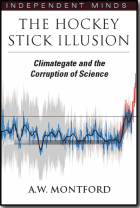
Yesterday morning I was delighted to see that Andrew’s Montfod’s book will be published on Monday. For those of us who have read his Bishop Hill blog over the last few years there should be a treat in store, and one that could not come at a better time.

hockeystickjacket3.png

A book length treatment of the Hockey Stick controversy is long overdue. Although David Holland’s  2007 paper on the subject for Energy and Environment did an excellent job of putting this strange tale in context for non-specialists, and Marcel Croc’s lengthy article in Natuurwetenschap & Techniek had provided much fascinating background prior to that, the only comprehensive source of information on this subject is the extensive posts  by Steve McIntyre at climateaudit.org, and these are definitely not for the faint hearted. In any case, both the Holland and Croc contributions have been overtaken by events as much has happened since their publication.

Michael Mann’s Hockey Stick graph has often been described as the icon of the global warming movement, and with good reason. Even more potent than dodgy representations of polar bears seemingly marooned on icebergs, this graph is an image that compellingly conjures up concerns about human influence on the climate that have come to dominate political, economic and social agendas worldwide during the last decade. It appears to give absolute scientific authority to all we have been told about a planet imperilled by human profligacy. Its message has been immensely persuasive, and in some respects this has been devastating.

At least since the 18th century, when the owners of grand country houses began to surround themselves with extensive parks, we have had a respect for the aesthetic and spiritual value of beautiful countryside. During the 20th century protection of this aspect of our heritage was incorporated into legislation. The green belts that surround many of our cities, the creation of National Parks and Areas of Outstanding Natural Beauty are examples of this. The planning laws in general have attempted to prevent the incursion of development in rural areas.

Back in 2004, I began work on a book about changing attitudes to the British landscape. I was puzzled and concerned that, soon after the start of the new millennium, a willingness to sacrifice a vital part of our cultural heritage by building wind farms had become acceptable. Just the kind of places which, only a decade or so previously, we would have struggled to preserve, were now being industrialised with no sign of widespread public outrage. My initial assumption was that an industrialised population had become detached from the natural world and was now indifferent to what was happening.

At that time media coverage of climate change amounted to little more than an occasional scare story about glaciers retreating or the latest prediction from a computer model; the usual outpourings of woe from the environmental movement. There seemed little reason to suppose that this amounted to more than just another fashionable scare story that would eventually run its course and fizzle out. I had already encountered a few: Continue reading »

An ‘Investigations Executive’ at the Advertising Standards Authority (ASA) wrote to me the day before the Climategate scandal broke.  Although the content of her letter was surprising, to put it mildly, subsequent events rather overshadowed it. Publication of the Climatic Research Unit’s emails, the collapse of the Copenhagen climate summit, and the lethargy of the Christmas holidays have postponed responding to the ASA’s letter.

Before I go any further, it is worth pointing out that the ASA is not a statutory body; it is not even an ‘authority’ in any accepted meaning of the term. It has no legal powers and nor is it charged by government with the duty of enforcing legislation. Quite why the word ‘Authority’ appears in its title is a mystery. Its remit extends no further than the advertising industry of which it is a part.

The ASA was founded in 1961 by the advertising industry as a means of self-regulating and of avoiding government regulation.  Funding is provided by a levy on advertisers. There are some interesting notes on the ASA’s history here. These mentions that, quite properly, the ASA operates under a chairman who has no connection with the advertising industry. I’ll come back to this in a moment.

So what did the ASA have to say in their letter? Well telling you is a bit of a problem because it’s all a terribly big secret. In fact, come to think of it, even telling you that I have received a letter from them would seem to be a terribly big secret, in their eyes at least. Just mentioning that there has been a letter I mean.  Perhaps I should really be pretending that none of this has ever happened.

Contributors to Harmless Sky who made complaints to the ASA may remember that we all received an acknowledgement from them which ended, ‘Please treat all correspondence as confidential until such time as a decision is published on our website’. This seemed a bit silly to me.

So far as I remember there were over 800 complaints to the ASA about the government adverts. Presumably each and every one of the complainants got the same letter, and this included the request for ‘confidentiality’. I’ve always believed that the only kind of secret that stays that way is one that you don’t share with anyone.

But of course such a request for confidentiality does beg a very obvious question; why is it being made?

I could think of no answer to that, so I thought little more about the matter. Normally, if someone wants to impart information on condition that it is confidential they seek your agreement first. Telling you something,and then saying that, by the way, ‘this is confidential’, is rather pointless, more particularly so when you are telling several hundred other people the same thing. And anyway, what possible justification could there be for trying to keep the very mundane information from the ASA that has appeared on this blog secret?

From a purely practical point of view, I could think of no sensible reason to make the request in the first place, or at least no reason that would reflect well on the ASA. Since I have been running this blog I have had dealings with a couple of proper regulators Ofcom and The Information Commissioner who do have statutory powers and neither of them have made such a request. Why should the ASA  do so?

The first requirement of a regulator is that the processes they employ in reaching decisions should be absolutely transparent, otherwise how does the public know that they are competent, impartial, and that they have applied the correct procedures and criteria in order to reach a equitable decision?  A secretive regulator is hardly likely to be a credible regulator.

In the end I decided that the ASA were probably just a bit self-important and unprofessional, and adjusted my expectations of what all those 800 complaints might achieve accordingly. That was until I received the letter that I mentioned at the beginning of this post: Continue reading »

© 2011 Harmless Sky Suffusion theme by Sayontan Sinha